


|
|
|
|
|
|
|
|
|
|
Jon Reiersen: Unions, Wage-Bargaining Institutions and Economic Performance | Copyright © 1998 The Author / Høgskolen i Vestfold |
|
[ Contents ] Browse: [ down ] [ up ] Unions, Wage-Bargaining Institutions by Jon Reiersen* Vestfold College Abstract: Are centralised systems of wage-setting good or bad for economic performance? By reviewing some of the theoretical literature, it is possible to identify both advantages and disadvantages of centralised wage-bargaining systems compared to more decentralised forms of wage-setting. Multiple factors contribute to good economic performance, and different bargaining systems may affect each one of these factors differently. While centralised bargaining might be good for unemployment by restraining union's wage demands, it may lead to lower work-effort and greater conflicts concerning work-organisation compared to a system with local bargaining. When it comes to encouraging productivity growth that requires investments on the part of the firm, however, centralised wage bargaining provides more appropriate incentives than local bargaining. The paper ends with an examination of factors that can explain why the Norwegian system of centralised bargaining seems to have performed quite favourably, and points to problems that might threaten the system in the future. * Paper prepared for the dr.polit. course "Comparative Perspectives on Work and Organizations", Oslo Summer School in Comparative Social Science Studies, University of Oslo 29.07-09.08. 1996. I would like to thank James Godbolt and Arne Kalleberg very for helpful suggestions and comments on earlier drafts of this paper. Correspondence: Department of Social Science, P.O. Box 2243, N-3103 Tønsberg, Norway, or e-mail to jon.reiersen@hive.no
[ Contents ] [ Top of page ] Browse: [ down ] [ up ] 1. Introduction Modes of wage-setting differ substantially across countries. In some countries, individual firms and workers determine wages, producing decentralised wage setting. In other countries, employer federations and unions bargain over wages, producing more centralised conditions. What are the impact of different wage-setting institutions on macroeconomic variables such as wages, unemployment and productivity? Are centralised systems of wage-setting, like the one we have in Norway, good or bad for economic performance? These are the main questions raised in this paper. During the last two decades the comparative study of wage-setting practices and other labour market institutions have obtained increased attention among social scientists and policymakers. One reason for this, is the divergence in macroeconomic performance since the beginning of the 1970s between the United States on the one hand and many European countries on the other. In 1995 Europe's unemployment rate, which had been about half those found in the United States throughout the 1950s and 1960s, had risen to twice of that found in the United States (10,8 percent versus 5,4 percent). Between 1970 and 1984, the United States achieved a growth in net employment of 33 percent, while the EU gained only 1 percent. In addition, unemployment of long duration is more pervasive in the EU than in the United States. Many analysts and policymakers have attributed the high level of unemployment and low level of job creation in Europe to the way in which wages are determined (see, e.g. OECD (1990) and Lindbeck et.al. (1994)). According to these commentators, the problem with the European labour market is that strong unions and relative centralised wage-bargaining have raised the wages of the lesser skilled, who have become too expensive. Employers are therefore unwilling to hire them or to invest in sectors or technologies that employ them. It is also claimed that employment protection laws, often introduced on the initiative of strong unions, tend to strengthen the bargaining power of those who already have jobs relative to those who do not have jobs. As a consequence, those who have jobs push up wages without risking losing their jobs. But, this again makes it even more difficult for unemployed to get jobs. From this perspective, strong unions not only limit short-run wage adjustments in the face of macroeconomic shocks, they also have harmful effects on the economy in the long run, in turn creating unemployment. This story, however, does not fit so well if we look back on the employment figures in Norway and Sweden from the early 1970s until the late 1980s. These two countries managed to hold unemployment rates under 2.5 percent at a time when unemployment in many other European countries rose above 10 percent. At the same time, Norway and Sweden were (and are) characterised by strong unions, relatively centralised wage bargaining and small wage differentials, the same factors that have been identified as causing unemployment in the rest of Europe. The Scandinavian discrepancy may indicate that the effects of different wage-setting systems may be far more complex than the commentators reviewed above suggest. The aim of this paper is therefore to discuss and compare the performance of different wage-setting institutions. The paper begins by discussing effects of wage-setting institutions on union wage demands and unemployment. The way wages are being set may also affect the economy in the long run by influencing the connection between the agreed-on wage and other decisions regarding investments, work-effort and job creation. This idea will be discussed in sections 3 and 4. Section 5 examines factors that can explain why the Norwegian system of centralised bargaining seems to have performed quite favourably, and what problems that may threaten the system in the future. Section 6 concludes the paper. The paper focuses only on the comparative performance of different wage-setting institutions. Possible effects of other labour market institutions, such as minimum wages, unemployment benefit systems, and active labour market policy will therefore not be discussed. Neither will I provide a systematic treatment of the empirical literature [ Contents ] [ Top of page ] Browse: [ down ] [ up ] 2. Wage Setting and Unemployment A theoretical framework for structural explanations of unemployment, taken from Layard et.al. (1991), is illustrated in Figure 1. The upward-sloping wage-setting curve illustrates how real wages and unemployment are related. When unemployment is low, workers press for higher wages because employment prospects are good. When unemployment is high, workers are in a weak bargaining position, and they moderate their wage demands. The downward-sloping curve is a standard labour demand schedule, which shows that higher real wages lead to lower demand for labour. The two curves are drawn in figure 1, and their intersection determines unemployment and real wages. This unemployment is often called the equilibrium rate of unemployment or the non-accelerating-inflation-rate of unemployment (Layard et.al., 1991). Figure 1. Equilibrium in the labour market 
Note: L=Labour force, N=Employment It can be seen from figure 1 that a wage curve that lies high in the diagram leads to high real wages and thereby high unemployment. A curve that lies high in the diagram means that wage pressure is high at a given level of unemployment, at it is here that the system of wage-bargaining comes in.1 [ Contents ] [ Top of page ] Browse: [ down ] [ up ] 2.1 Degree of centralisation and wage demands An important goal for trade unions is, of course, that members receive a high real wage. A high real wage can, however, lead to a reduction in the number of jobs since the demand among firms for labour is lower, the higher real wages are. High nominal pay rises, then, may provide increased purchasing power, but also fewer jobs. Therefore unions have to trade off the benefits of a nominal wage increase against the associated loss of employment. But, as Calmors and Driffil (1988), among others, have shown, this trade-off looks different according to whether one views it from the perspective of a union bargaining at the plant or firm level, the industry level or the national level. The central conclusion of these studies has been that both highly centralised and highly decentralised systems of wage bargaining are likely to produce moderate real wages and low unemployment. The highest aggregate real wage and the highest unemployment may be associated with intermediate centralisation in the form of bargaining at the industry level. Consider first the case of wage-setting at the individual firm (complete decentralisation). If the union sets a high nominal wage, this will be passed on in the firm's price. Given the high degree of substitutability between the products of firms in an industry, the firm in question would lose a substantial amount of demand. As a consequence, it would cut back employment sharply. This scenario will probably prevent the firm-level union from pushing up wages. For the economy as a hole, consisting of many firms, the result will be a low equilibrium rate of unemployment. If wage bargaining takes place at the industry level, a wage increase will have a significantly lesser effect on employment. Higher wage and price rises at the industry level will result in a relatively limited reduction in demand and employment since the degree of substitutability between the products of different industries is small. An increased nominal wage in an industry will lead to an increase in prices in that industry, which in turn results in an increased consumption price, but the rise in the consumption price will be much weaker than the product price increases in the industry. This means that the union's real wage will rise by almost all the increase in nominal wages. The industry union therefore believes it faces a relatively advantageous trade-off between higher real wages and employment. The result is the adoption of an aggressive wage policy. When all unions try to raise nominal wages, however, the result for the economy as a whole is a wage curve that lies high up in Figure 1, and that thereby leads to a high equilibrium rate of unemployment. A union that bargain at a national level will supposedly take such effects into account. It will know that "(...) one man's wage increase is mainly another man's price increase" (Layard et al., 1991, p. 132). If the union sets a high nominal wage, it knows that this will be passed on by all firms in higher prices. Real wages will not rise. A centralised union on the national level internalises, in a way, the external effects of increased nominal wages, via increased prices in the economy, and therefore, it will desire a lower wage level than industry-level unions. Again, for the economy as a whole the result will be a low equilibrium rate of unemployment. According to this story, the relationship between centralisation and unemployment is hump-shaped, as shown in figure 2. Both highly decentralised and highly centralised bargaining systems produce greater wage restraint and lower unemployment than bargaining systems in between.2 Figure 2. The "hump-shaped" relationship between centralisation and unemployment 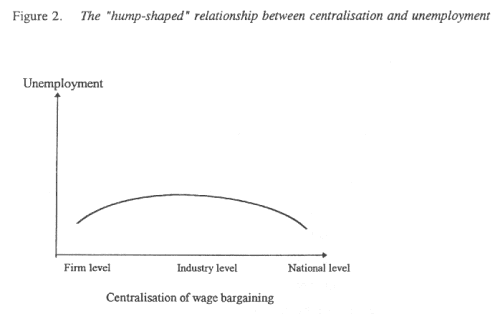
[ Contents ] [ Top of page ] Browse: [ down ] [ up ] 2.2 Other internalisation effects and centralisation The basic idea in the stylised model discussed above is that wage increases for one group have negative externalities for others that are internalised under centralised bargaining; hence, centralised bargaining creates incentives for wage restraint. Such internalisation effects have, however, been discussed within a number of different theoretical frameworks, and a number of other externalities in the wage-setting process have been identified that might induce a central wage-setter to choose differently than a decentralised wage-setter (Moene and Wallerstein, 1993; Calmfors, 1993). For example, firms depend on the labour of workers whom they do not directly employ. An input price externality may arise when wage increases in one part of the economy cause price increases for the products used as material inputs by other firms. The consequence may be lower output and employment in other parts of the economy. A fiscal externality is imposed on the rest of the economy if wage increases in one sector cause unemployment there to rise. Increased unemployment reduces tax revenues in the affected sector and increases expenses in the form of unemployment benefits. This can lead to the imposition of higher taxes in the rest of the economy. An unemployment externality may also arise under decentralised wage-setting: If real wages and unemployment rise in one sector, it becomes more difficult for the unemployed everywhere in the economy to find new jobs. These externalities have all been used to explain why centralised bargaining is likely to produce a lower aggregate real wage and, hence, lower unemployment. Calmfors (1993) puts it this way; "The simple idea is that inter-union (...) co-operation implies that the effects on others of wage increase in one part of the economy will be considered. Thus the marginal benefit of real-wage increase is reduced and/or the marginal cost increased. As a consequence, the incentives to real-wage restraint ought to be strengthened when bargaining is centralised" (p. 164). [ Contents ] [ Top of page ] Browse: [ down ] [ up ] 2.3 Different dimensions of decentralisation Thus far we have focused on only one dimension of centralisation, the firm-industry-nation dimension, or on what Moene and Wallerstein (1993) have labelled the extent of vertical centralisation. There are, however, other dimensions as well. Firms are typically dependant on different types of labour, which are often represented by different unions. This is true, for example, in the United Kingdom, where several unions that represent different professions and that bargain independently co-exist in the same workplace. Similar conditions exist in the Nordic countries, where blue-collar and white-collar workers have separate unions that bargain independently. When workers are organised according to profession across firms and industries (horizontal centralisation), the unions' optimal wage may also then depend on the degree of centralisation. Workers belonging to different professions can be very difficult to substitute with one another. When a union tries to raise wages for its own members, it knows that it is difficult for firms to substitute these workers with others, even if they would like to. This knowledge can lead to quite militant wage demands from individual unions. However, different unions are typically complements in production; that is, the productivity of labour from one union is enhanced by the presence of labour from other unions. An example is labour from different unions located at different stages in a common process of production. In this case, one union's wage increase reduces the demand for the labour supplied by other unions. If one draws a diagram with the extent of horizontal centralisation and real wages on the axes, one should therefore expect a monotonically negative relationship between the two variables. While an individual union leadership considers only the impact of a wage increase on the employment of its own members, the central leadership of a confederation most likely takes into consideration the impact of a wage increase on the employment of all categories of workers within the confederation. A consideration of the relative bargaining strength of unions yields similar conclusions. The bargaining power of individual unions often becomes greater when unions bargain separately instead of jointly. This is because in most cases individual groups of workers can by themselves inflict heavy production losses on the employer, exactly as if the entire workforce goes on strike. At the same time, the costs of giving in under bargaining and increasing wages are less for firms when the negotiations concern only a part of their workforce. For this reason firms yield more readily in wage negotiations when professional groups bargain separately (Horn and Wolinsky, 1988). [ Contents ] [ Top of page ] Browse: [ down ] [ up ] 3. Wage Bargaining, Choice of Effort and Investment In the previous section, the basic question was: How do different levels of centralisation affect the optimal wage from the unions' point of view. In reality, however, unions rarely set wages unilaterally. Rather, the wage contract is the result of a bargaining process between employees and employers, in which both parts must "give and take". This fact leads to an equally important question: How do local versus central bargaining influences the connection between the agreed-on wage and other economic decisions? Or, as Moene and Wallerstein (1993) note, "The basic problem in collective bargaining is how the quasi-rents that are inherent in the employment relationship should be divided between workers and employers. (...) The question of how the structure of bargaining affects the surplus to be bargained over is as important as the question of how bargaining structure affects the way the surplus is divided. This leads to two separate issues of efficiency. The first is the efficiency of the bargaining process itself or the ability of bargainers to reach agreement without engaging in strikes or lockouts. The second issue, perhaps the most important, concerns the impact of the centralization of bargaining on decisions regarding other variables that are not bargained over." (p. 94). Two variables seem particularly important; workers' efforts on the job and investment. Let us first look at workers' efforts. In most jobs, the individual worker has a great measure of control over his own efforts. This applies in any case to decisions about how efficiently one carries out different work tasks and the quality of the completed work. Other aspects of workers' effort are, however, decided collectively, as when new work methods and production techniques are introduced. The level at which wage bargaining takes place can be important for efficiency and for conflicts surrounding the organisation of work. During wage negotiations, a union can threaten with strikes or other actions if its wage demands are not met. To prevent the loss associated with conflict, it may be profitable for employers to give in to wage demands. The higher the firm's profits, the more the union is able to take out in wages. When profits are low, unions must settle for lower wage growth. All wage bargaining thus entails a sort of profit-sharing. The profit that is an object for bargaining, however, depends on whether bargaining takes place within an individual firm, in an industry, or at the national level. At the local level, wage bargaining is a form of profit-sharing between the individual firm and its workforce. Therefore, there will be a direct relationship between how high work effort is in that particular firm and the wage that workers can achieve through negotiations. Local bargaining can thus function as an incentive mechanism, which rewards high work effort. If wage bargaining takes place at a higher level, the profits to be shared through bargaining are aggregated over an industry or entire economy. Then there is no noticeable connection between how high workers' efforts are in an individual firm and the wage those workers receive as a result of bargaining. The element of incentive is, then, weakened in the case of industrywide or more centralised agreements. Without local bargaining, one should therefore expect lower production efficiency and greater conflict concerning the organisation of work and new production methods. When it comes to encouraging productivity growth that requires investments on the part of the firm, however, centralised wage bargaining provides more appropriate incentives than local bargaining (Grout, 1983). In local bargaining, workers receive a share of the profits that the investments may bring, through the implicit profit-sharing. But, this means that also the firm only receives a share of the income resulting from the investment at the same time that it must bear all investment costs. It follows that investments are less profitable for firms than they are for society, and the result can be underinvestment. When wages are set on a central level, there is no such direct connection between investment undertaken by an individual firm and the profits that are shared in bargaining. Firms perceive wages as exogenously given, and the increased profits from their investments are theirs to keep. Central wage bargaining, then, provides more correct incentives for investments in the private sector. [ Contents ] [ Top of page ] Browse: [ down ] [ up ] 4. Wage Bargaining, Job Creation and Productivity In the previous section, we discussed how wage bargaining held at different levels influences investment and efficiency in already-established firms. But, the level at which wage negotiations take place can also influence job creation and employment through the establishment of new firms and the shutting down of old ones. Schumpeter (1942) regards the closing down of old enterprises and the establishment of new as the fuel of the capitalist economy. This dynamic is to be found in what Schumpeter termed "the process of creative destruction." The process of change takes place when new firms and enterprises establish themselves by applying old techniques in new and more effective ways. Such new enterprises will continuously drive the least efficient entities out of the market and create economic growth and progress. Traditionally, strong unions and small wage differentials have been seen as hindrances to growth and adjustment to changing market opportunities. Evening out wage differences means that wages are held down for the most highly skilled workforce. The argument is that this will have a negative effect on the incentives to invest in further education and training. Further, a compressed wage structure makes it difficult for the most efficient industries to attract labour by offering a wage premium. Moene and Wallerstein (1995) and Agell and Lommerud (1993), however, turn this conventional wisdom on its head by arguing that centralised bargaining that eliminates wage differentials, not only among plants within an industry but also among industries, can contribute to making an industry more productive. Following Moene and Wallerstein (1995) this can be explained in the following way: Newly established firms or plants have access to the newest and most productive technology, and are therefore more productive than old plants. In other words, it is assumed that productivity growth is embodied in new plants and equipment. Over time, the economy becomes more productive as new plants are built and older plants are shut down. The difference between local bargaining and centralised bargaining at the industry or national level, can be illustrated as in figure 3. Plants are arranged along the horizontal axis from newest to oldest. The declining curve that begins at b0 is the revenue produced by a plant of each vintage. As discussed in section 3, all wage bargaining entails a sort of implicit profit-sharing. At the local level, wage bargaining is a form of profit-sharing between a firm and its work force. Since revenue per worker is highest in the most productive firms, the wage (w) with local bargaining will also be highest in the most productive firms. In figure 3, locally set wages are assumed to be a fixed proportion (a) of each plant's revenue per worker, until the constraint w ³r becomes binding. r represents a kind of "outside-option" that can be interpreted as income from other alternatives (self-employment, unemployment benefit etc.). Wages can not fall below r. The wage in the least productive plants therefore remains constant until one reaches the plant whose productivity is just high enough to pay w=r and make zero profits. Figure 3. The distribution of wages across plants with local and industry/national level bargaining. 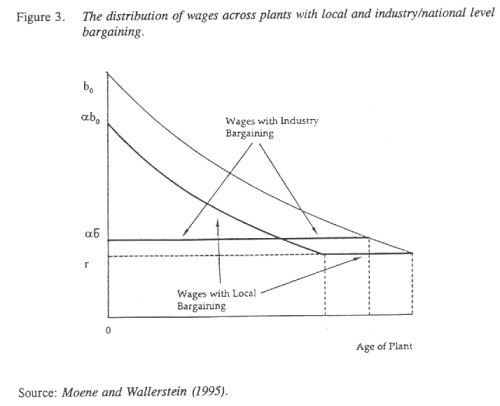
Source: Moene and Wallerstein (1995). With centralised bargaining, the profits that are shared are
aggregated over the whole industry or the whole economy. As figure 3 shows, with
centralised bargaining the wage is set as a proportion
(a) of the
average revenue ( It can then be seen from figure 3 that local bargaining raises wages in newer plants, since workers here are able to capture a share of their above-average productivity, while it reduces wages in plants with below-average productivity, compared to centralised bargaining. When bargaining is centralised, the least efficient plants are prevented from lowering their wages, and as a consequence, marginal plants are pushed out of the market much earlier than in the case with local bargaining. This in turn lowers the average age of plants in operation and thereby increases the average productivity of the industry. While centralised bargaining in this model is good for productivity, it is more uncertain how different bargaining systems affect the number of new plants that are built and old plants that are shut down in each period (job creation). Centralised wage bargaining that sets an uniform wage in all plants with different productivity has approximately the same effects as if newly established firms are subsidised and older firms are being taxed. This has two counteracting effects on job creation. While centralised bargaining creates a lower entry barrier for more efficient plants, which implies that more new plants may be built, it also forces less efficient plants to shut down at a faster rate compared to local wage negotiations. Thus, whether or not centralised bargaining is more efficient than decentralised bargaining, in the sense of raising productivity and employment simultaneously, is not clear.3 [ Contents ] [ Top of page ] Browse: [ down ] [ up ] 5. Institutional Changes According to conventional economic theory, a country such as Norway with its strong unions, should face major problems achieving full employment. Strong unions can easily create unemployment by pushing for increases in real wages and thereby limiting production, such that employees receive a portion of the monopoly profits created when product prices rise. The Norwegian experience, however, runs counter to the view that the stronger the unions, the worse off the economy. As Table 1 shows, Norway managed to hold unemployment down to approximately 2 percent throughout a period in which unemployment increased dramatically in a number of other European nations. One reason may be that the labour movement in Norway has been more centralised than in most other countries. For a variety of reasons, as discussed in this paper, national-level unions are likely to be more sensitive to unemployment than industry-level unions when they set their wage demands. But, if the Norwegian wage bargaining system not in itself create significant unemployment, this does not, however, mean that the system automatically counteracts unemployment created in other ways. As shown in table 1, the difference between unemployment in Norway and in the rest of Europe narrowed during the early nineties. Table 1. Unemployment rates in some European countries;1975-95. 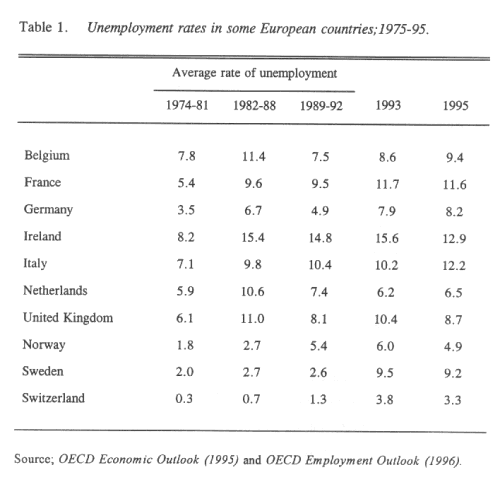
Source; OECD Economic Outlook (1995) and OECD Employment Outlook (1996). Unemployment in Norway rose from approximately 2 percent in 1987 to 6 percent in 1993. If we also include workers enrolled in active labour-market programs, the unemployment rate increases to 8 percent. The growth in unemployment was caused primarily by the strong reduction in aggregate demand in Norway in the end of the 1980s (Rødseth, 1994). In 1984, Norway's credit market was deregulated. This led to a dramatic growth in private consumption, followed by growth in investments, employment, and prices. Most of the growth in consumption was, however, financed by loans, and such a loan-financed upswing could not last. After a while, many attempted to reduce their debt by selling property or in other ways paying off their loans. The result was a great downturn in private consumption that occurred simultaneously with a fall in demand in the rest of Europe as well. "The boom" ended in a strong recession followed by a significant rise in unemployment. This development demonstrated that centralised wage-setting alone is not enough to hinder unemployment growth. The reason that Norway was able to maintain full employment, despite high unemployment in many other countries, was more due to the favourable interplay of several forces, in particular macroeconomic stabilisation policy on the one hand and wage-setting practices on the other. As Cappelen et al. (1992) points out, the Norwegian system can be characterised as a kind of institutional balance, with "mutual gift exchanges" between the Government and the labour movement. From the Second World War until today, the Norwegian authorities have followed an active economic policy of hindering unemployment. Tools have included devaluation together with macroeconomic demand stabilisation. The way in which wage-setting is organised, however, has an important impact on the effects of such policies. For example, a devaluation in the face of strong and fragmented unions may have no effect whatsoever, because a reduced real wage will quickly be compensated for by aggressive wage demands. The official policy of full employment has therefore been dependant on a disciplined labour movement and moderate wage demands for its effectiveness. In a sense, the Norwegian authorities have been able to trade a full employment policy for permission to govern effectively, while the labour movement has traded moderate wage demands for a promise of full employment. Today several factors threaten to upset this institutional balance. Increased international integration and free capital mobility have reduced the number of macroeconomic policy tools available to the authorities. If unemployment rises, it may therefore be quite difficult for them to reduce it again through the use of traditional stabilisation policy. The question is, then, why trade unions should moderate their wage demands in order to increase aggregate employment when unemployment may easily become high anyway. Co-ordinated action on the part of unions will become almost impossible if the individual unions do not see clear advantages to centralised wage-setting. If the authorities no longer have the ambition or tools available for maintaining full employment, the exchange of wage demand moderation for a guarantee of full employment comes to an end, and the entire institutional balance is in danger. The institutional balance is also threatened by the steadily growing internationalisation of business. Norwegian workers employed by companies with subsidiaries in several countries have an interest in their wages being on the same level as the wages paid elsewhere in the company. National co-ordination of wages can then conflict with the necessary considerations of conditions within the company. In addition, it is difficult to imagine centralised wage-setting without the simultaneous flattening of wage differentials among sectors and among worker groups. Technological developments and the steadily cheaper costs of transportation can, however, make a compressed wage structure difficult to maintain over time. A lowering of wage differentials leads to low-skilled labour being seen as expensive for firms, while highly skilled labour comes to seem inexpensive. When low-skilled labour becomes ever more interchangeable, a high wage level for this group results in ever higher unemployment. An example is ship-building. The hull of a ship can easily be built outside the country using cheap, low-skilled labour, then be taken to Norway where the production tasks requiring highly skilled labour can be performed. Although the Norwegian system of wage bargaining seems to have performed quite favourably, it is not certain that it will survive. How the system develops will be decided primarily by the conditions characterising the environment of the parties, conditions which neither party can control. Both the authorities and the labour organisations may therefore have limited abilities to steer the development of the system itself. 4 [ Contents ] [ Top of page ] Browse: [ down ] [ up ] 6. Concluding Remarks Modes of wage-setting differ substantially across countries. In some countries, individual firms and workers determine wages, producing decentralised wage setting. In other countries, employer federations and unions bargain over wages, producing more centralised conditions. What are the impact of different wage-setting institutions on macroeconomic variables such as wages, unemployment and economic growth? Are centralised systems of wage-setting, like the one we have in Norway, good or bad for economic performance? These are the main questions raised in this paper. The discussion did not, however, provide any unambiguous conclusions. The main reason for this is that there are multiple inputs that contribute to good economic performance and different wage-setting institutions may affect each differently. Consider for example the effects of centralised wage bargaining on work effort and investments. All wage bargaining entails a sort of profit sharing. With centralised wage-setting, the profits to be shared through bargaining are aggregated over an industry or the entire economy. Then there is no noticeable connection between how high workers' effort is in an individual firm and the wage those workers receive as a result of bargaining. This provide little incentives for workers to work hard. With local bargaining however, there will be a direct relationship between how high work effort is in that particular firm and the wage that workers can achieve through negotiations. Local bargaining can thus function as an incentive mechanism, which rewards high work effort. When it comes to encouraging productivity growth that requires investments on the part of the firm, however, the result is exactly the reverse. Local bargaining discourages investments since the firms has to pay all investment costs at the same time that it only receives a share of the profits that the investment may bring, through the implicit profit-sharing. When wages are set on a central level, firms perceive wages as exogenous, and the increased profits from their investments are theirs to keep. In other words; the best wage-setting system for capital formation may be the worst for workers' effort. One main virtue of a centralised wage-setting system may be that central negotiators are forced to consider the effects of wage settlements on the entire economy. For a number of reasons, wage increases for one group may have negative externalities for others, but such externalities will be considered under centralised bargaining. As a consequence, the incentives to real-wage restraint ought to be strengthened when bargaining is centralised. Thus, concern with unemployment argues in favour of centralised bargaining. Yet, in a world with fast-mowing market developments and where different sectors face different market conditions, it is important for firms to have the ability to design wage contracts that can be tailored to the particular situation facing individual workers and firms. This speaks for decentralised wage-setting. On the other hand, wage contracts tailored for the particular situation facing an individual firm, means that wages will be highest in the most productive firms and lowest in the least productive firms. This can be bad for productivity growth. Centralised wage setting that sets an uniform wage in all plants with different productivity has approximately the same effects as if high productive firms are subsidised and low productive firms are being taxed. Thus, centralised wage-setting creates a lower entry barrier for more efficient plants, which implies that more new plants may be built, at the same time that it forces less efficient plants to shut down at a faster rate compared to decentralised wage bargaining. Thus, the best wage-setting system for short-term adjustment to fast-moving market developments may be the worst for long-term productivity growth. Even though different wage-setting institutions may have important consequences for employment and economic growth, the system of wage-setting can not alone explain differences between countries. Other labour market institutions and macroeconomic policy may be equally or more important. Finally, the central issue should perhaps not be the identification of a particular wage-setting institution which "work best". Centralised wage bargaining systems for example are found primarily in small countries. It is not evident that labour market institutions developed in one country, or in a group of more or less similar countries, can be "exported" to another. If so, the central issue for future research should be to try to identify specific institutions and policies which can succeed in particular environments, and not the identification of a particular wage-setting institution which works best. [ Contents ] [ Top of page ] Browse: [ down ] [ up ] Endnotes
1 Within this theoretical framework, the position of the curves, and thereby the equilibrium rate of unemployment, are independent of aggregate demand. Increased demand can, however, lead to a situation in which unemployment is lower than the equilibrium rate of unemployment, but this creates increased wage and price pressure and in the long run "forces" unemployment back to the equilibrium rate.
2 There is some empirical evidence in support of this relationship. Examples of economies with centralised wage-setting and relatively low unemployment are the Scandinavian economies (excluding Denmark) and Austria. Examples of economies with decentralised wage-setting and relatively low unemployment are the USA, Japan, and Switzerland (Calmfors and Driffil, 1988). Fitting in the middle group with an intermediate level of centralisation of bargaining and poor unemployment records are the economies of the European core; West Germany, France, Italy and the UK. But, there are also many economies that fail to fit the story neatly, for example Denmark with its fairly centralised wage-setting structure but a poor unemployment performance.
3 A more detailed discussion and mathematical proofs are given in Moene and Wallerstein (1994; 1995).
4 Other factors that can explain why the Norwegian system is in trouble, are discussed in more depth by Moene and Wallerstein (1995).
[ Contents ] [ Top of page ] Browse: [ down ] [ up ] References Calmfors, L. 1993. The Extent of Centralization of Wage Bargaining and Macroeconomic Performance. MS. Paris: OECD. Calmfors, L. and J. Driffill. 1988. Bargaining Structure, Corporatism and Macroeconomic Performance. Economic Policy, 3: 13-61. Cappelen, Å., K.O. Moene and R. Nymoen. 1992. Fra Full Sysselsetting til Varig Høy Arbeidsledighet. Nordic Journal of Political Economy, 23: 17-38. Freeman, R.B. 1993. How Labor Fares in Advanced Economies. In R.B. Freeman (ed.) 1993. Working Under Different Rules. New York: Russel Sage Foundation. Grout, P.A. 1993. Investment and Wages in the Absence of Legally Binding Contracts: A Nash Bargaining Approach. Econometrica, 52: 449-60. Horn, H. and A. Wolinsky. 1988. Worker Substitutability and Patterns of Unionization. Economic Journal, 98: 484-97. Layard, R., S. Nickell and R. Jackman. 1991. Unemployment; Macroeconomic Performance and the Labour Market. New York: Oxford University Press. Lindbeck, A., P. Molander, T. Persson, O. Petersson, A. Sandmo, B. Swedenborg, and N. Thygesen. 1994. Turning Sweden Around. Cambridge: MIT Press. Moene, K.O. and M. Wallerstein. 1993. Bargaining Structure and Economic Performance. In R.J. Flanagen, K.O. Moene and M. Wallerstein. 1993. Trade Union Behaviour, Pay-Bargaining and Economic Performance. New York: Oxford University Press. Moene, K.O. and M. Wallerstein. 1994. Egalitarian Wage Policies. Memorandum no. 9, Oslo: Department of Economics, University of Oslo. Moene, K.O. and M. Wallerstein. 1995. How Social Democracy Worked: Labor-Market Institutions. Politics & Society, 23: 185-211. Organization for Economic Cooperation and Development. 1990. Labour Market Policies for the 1990s. Paris: OECD. Organization for Economic Cooperation and Development. 1995. Economic Outlook. Paris: OECD. Organization for Economic Cooperation and Development. 1996. Employment Outlook. Paris: OECD. Rødseth, A. 1994. Vegen til Høg Arbeidsløyse. In A. Sandmo (ed.) 1994. Perspektiv på Arbeidsledighet. Bergen: Fagbokforlaget. Schumpeter, J. A. 1942. Capitalism, Socialism and Democracy. New York: Harper and Row. |
|
|
|
 |
Copyright ©
1998
The Author / Høgskolen i Vestfold
Copyright information: http://www-bib.hive.no/tekster/hveskrift/notat/1998-1/copyright.html